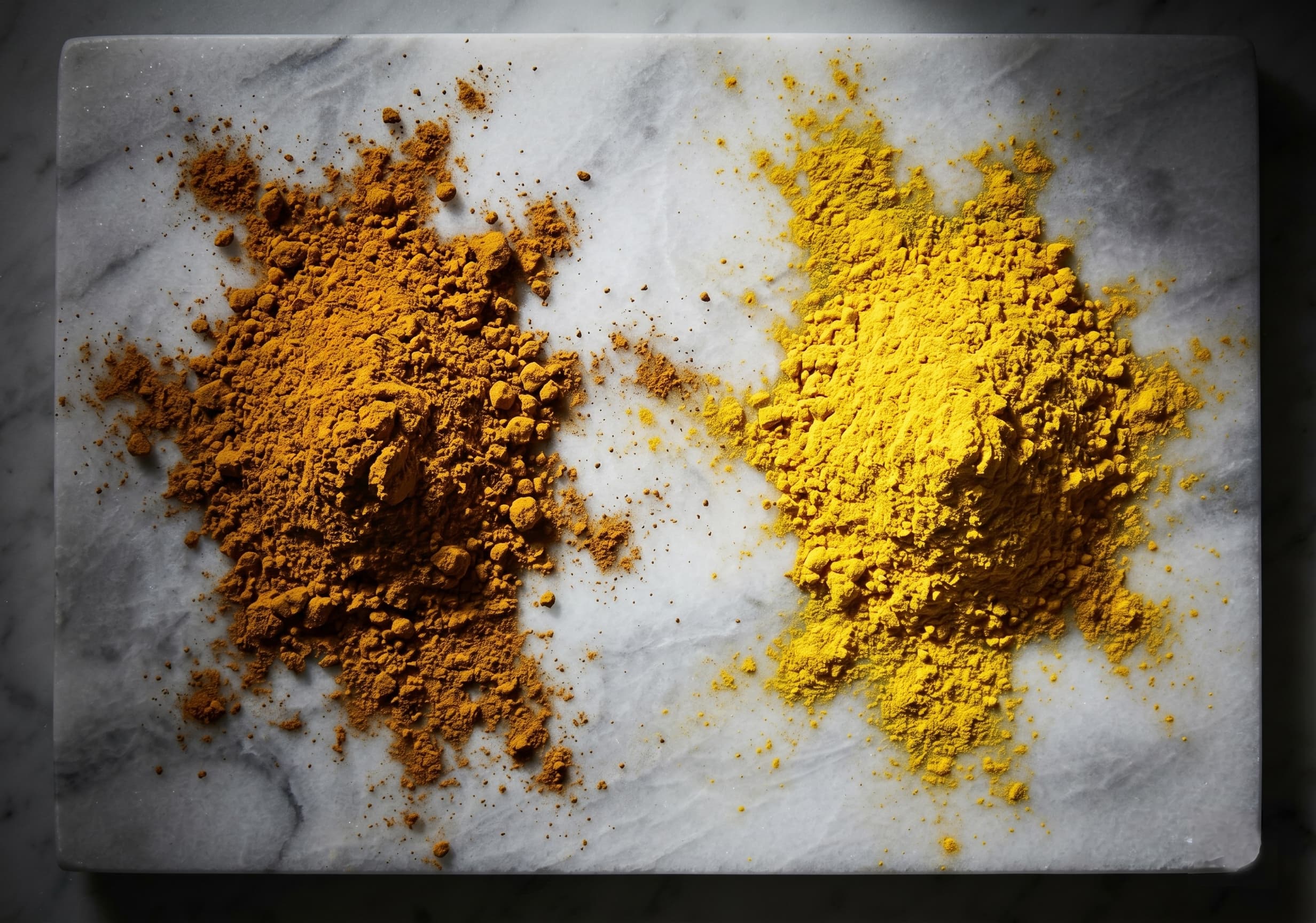
Why Darker Turmeric is Better: The Science Behind High Curcumin Colour
Think darker turmeric is a defect? Think again. We explain why high curcumin turmeric is naturally darker — and what that bright yellow in your spice box actually tells you.
Open a jar of HAARIDRA and you'll know immediately that something is different.
The colour isn't the bright, vivid yellow you've grown up associating with turmeric. It's darker. Earthier. Richer in tone. Your instinct might be to question whether something is off with the product.
That instinct is understandable. It is also the product of decades of conditioning by mass-market turmeric brands that optimised for visual appeal over medicinal potency.
Here's the truth: darker turmeric isn't a defect. It's a signal.
What Gives Turmeric Its Colour?
Turmeric's colour comes from a group of compounds called curcuminoids — the most prominent of which is curcumin.
Curcumin is the primary bioactive compound in turmeric. It is the molecule responsible for most of turmeric's well-documented properties — anti-inflammatory, antioxidant, and a range of applications studied extensively in modern research as well as documented in Ayurveda for over 4,000 years.
Curcumin is also a pigment.
The higher the curcumin concentration in a batch of turmeric, the deeper and richer the colour of the resulting powder. This relationship is direct and consistent. High curcumin = dark, earthy, golden-brown. Low curcumin = bright, uniform, vivid yellow.
The Dark Chocolate Analogy
The simplest way to understand this is the dark chocolate comparison.
Dark chocolate — 70%, 80%, 90% cocoa — is visually darker, more intense in colour, and more bitter in taste than milk chocolate. The darkness tells you immediately that there is more cocoa present. You don't need a laboratory to understand that.
Milk chocolate is paler, sweeter, more visually "appealing" to many consumers — but that appeal comes at the cost of cocoa content.
The same principle applies to turmeric.
Why Is Commercial Turmeric So Bright?
This is the more important question.
1. Low-Curcumin Varieties Many commercial turmeric brands use varieties bred specifically for high yield and visual uniformity — not medicinal potency. These varieties produce bright, vivid powder that photographs well and looks consistent across batches. The curcumin content is not the priority.
2. Blending Large manufacturers often blend turmeric from multiple sources, including lower-quality rhizomes, to achieve visual and flavour consistency across massive production volumes. This dilutes curcumin concentration further.
3. Permitted Colour Addition Under Indian food regulations, food colour E100 — which is synthetic curcumin extract — is legally permitted in packaged turmeric powder. Many brands use this to achieve a bright, consistent colour regardless of the actual curcumin content of the raw material. This is legal. It is also something you should know when you read the ingredients list of your current pack.
4. Chemical Brightening Some processors apply permitted washing or brightening treatments to raw turmeric rhizomes before grinding, further enhancing the visual brightness of the final product.
What HAARIDRA Does Differently
HAARIDRA is grown at Village Vasravi, Tal. Mangrol, Dist. Surat, Gujarat — on certified organic land that has never seen a synthetic fertiliser or chemical pesticide.
The turmeric is hand-harvested when the rhizomes have reached full maturity. It is sun-dried — not machine-dried under artificial heat — because sun-drying at ambient temperature preserves volatile compounds and curcumin far more effectively than forced hot-air drying.
It is ground on stone. Low speed. Low temperature. No industrial high-speed milling that generates heat during the grinding process itself — a less-discussed factor that degrades curcumin before the powder even reaches the jar.
No colour is added. No brightening is applied. No blending with lower-grade material.
What you receive is exactly what was grown and processed.
Why We Don't Print Curcumin % on the Label
You may have noticed that HAARIDRA does not list a curcumin percentage on the label.
This is intentional, and it requires explanation.
Curcumin content in organically grown, non-standardised turmeric varies naturally from batch to batch. This variation is a feature, not a flaw — it is what you would expect from genuine agricultural produce, just as wine vintages vary or mango harvests differ year to year.
Printing a fixed curcumin percentage on the label would require us to either:
- Guarantee a minimum and potentially overclaim some batches, or
- Standardise the product through blending — exactly what we are trying to avoid.
Instead, every batch of HAARIDRA is independently lab-tested. The complete report — curcumin content, heavy metals screening, pesticide residue analysis, and microbial safety data — is accessible via the QR code on your jar.
Your jar. Your batch. Your report.
How to Use High Curcumin Turmeric
A few practical notes for first-time users:
Use slightly less than usual. If you regularly add one teaspoon of turmeric to a recipe, start with half a teaspoon of HAARIDRA. The higher potency means a smaller quantity achieves the same culinary effect — and more in the pot is not always better.
Pair with black pepper. Piperine, the active compound in black pepper, is known to significantly enhance curcumin absorption. A small pinch of black pepper alongside your turmeric — whether in food, golden milk, or turmeric tea — makes a measurable difference.
Golden milk before sleep. Half a teaspoon in warm milk with honey is the most traditional and effective daily use. Anti-inflammatory, calming, and easy to incorporate as a nightly ritual.
The Bottom Line
If your turmeric is very bright yellow, ask yourself why.
Genuine high-curcumin turmeric, grown without chemical interference and processed without colour additions, is naturally darker. It has always been this way. The standardised bright yellow of commercial turmeric is a relatively recent phenomenon — driven by market aesthetics, not agricultural truth.
The colour of HAARIDRA is not a problem to overcome. It is exactly what it should be.
Shop HAARIDRA at jirumithufarms.com India Organic Certified · Jaivik Bharat · FSSAI Licensed · Batch-Wise Lab Reports
Continue Reading
More from the Blog
Why We Pack in Glass (And Why Plastic is Not a Neutral Choice)
The packaging of your spices affects what you receive. We explain why Jiru Mithu Farms uses only eco glass jars — and what plastic packaging is actually doing to your turmeric and moringa.
Why We Pack in Glass: The Case Against Plastic in Your Kitchen
Every major spice brand packs in plastic. It is cheaper, lighter, easier to ship. We chose glass anyway. Here is the full reasoning — and why it matters more than most people realise.
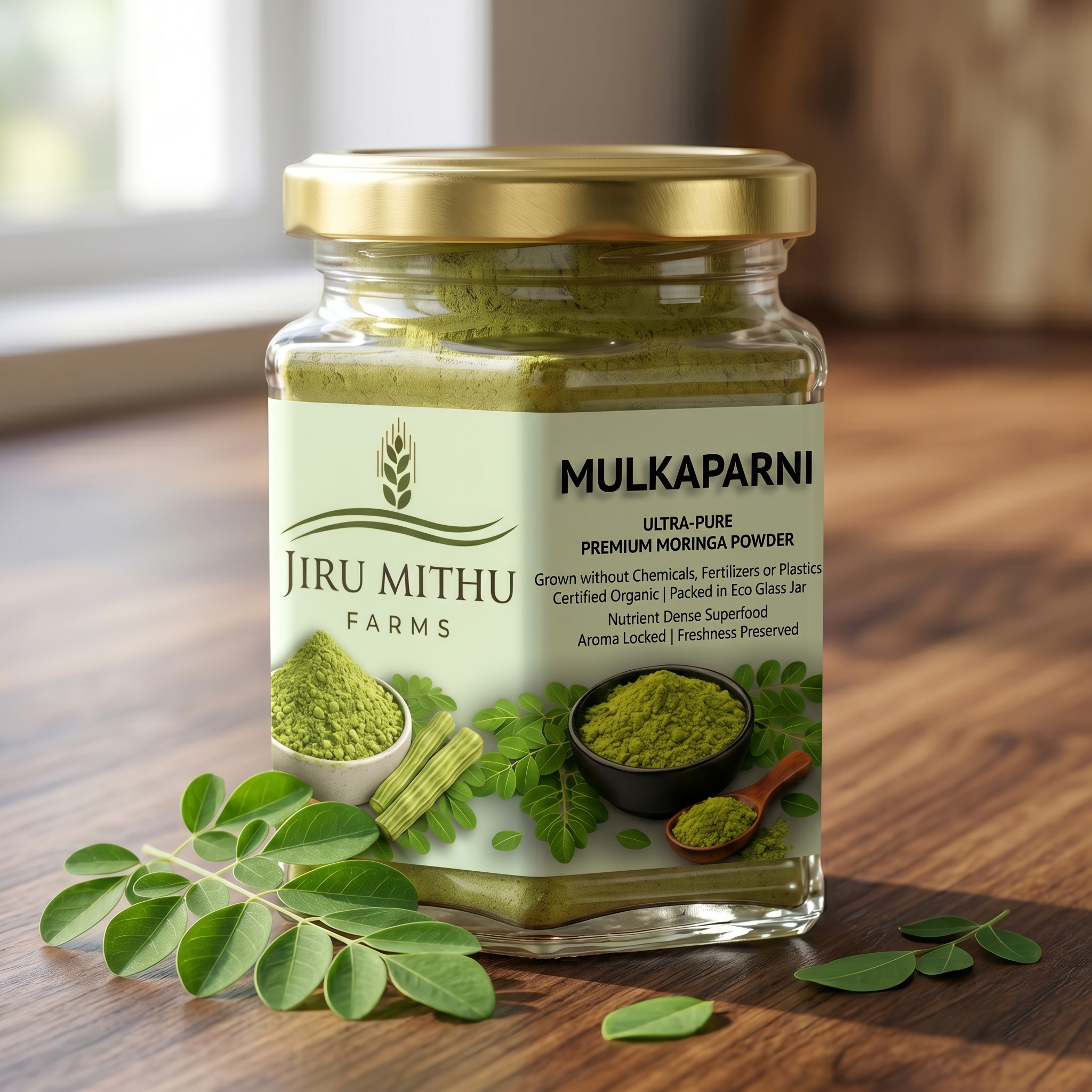
What is Moringa? The Complete Guide to the Miracle Tree — and MULKAPARNI
Moringa oleifera — the Miracle Tree. What's actually in it, who benefits most, how to use it daily, and why most moringa powder doesn't deliver what the plant is capable of.
From the Farm